The POINTBLANK Plan
Part Seven: Combined Bomber Offensive strategic priorities and target selection

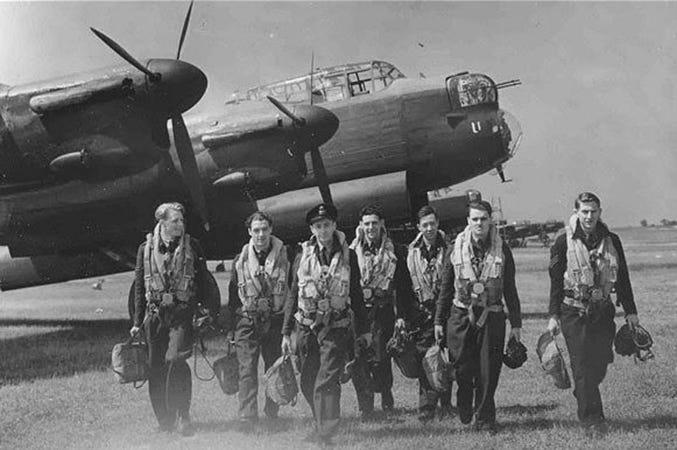
One of the selling points of strategic airpower was its technocratic appeal. Here, its proponents claimed, was a mode of warfighting based on scientific principles of statistical analysis and rational calculation. Though it would be an exaggeration to say that the airpower prophets disregarded the human factor, it was to some extent downgraded. The commanding officer of a strategic air force was more of a manager than an inspirational leader. And he was, perforce, a remote figure, far removed from the world in which the crews of USAAF and RAF bombers lived. All high-level war planning appears bloodless by comparison with reality at the sharp end, of course. An operations officer moves a pin on the map; an infantryman crawls forward on his belly. And in no other aspect of the Second World War was this more notable than in the planning of the strategic air offensive against the Axis powers.
The POINTBLANK Directive from the Combined Chiefs of Staff to the US Eighth Air Force and RAF Bomber Command, issued in June 1943, set forth in very general terms the priority objective of the Combined Bomber Offensive (CBO): to cripple German airpower ahead of a wide-raging air campaign against Germany’s industrial infrastructure and the Allied invasion of France. To that end, attacks would focus initially on industries and infrastructure supporting the Luftwaffe. Only later would the target set expand to encompass other essential industries. Detailed planning for the CBO thus boiled down to a matter of target selection: which targets to strike, in what order of priority, with what level of intensity, to achieve decisive results in the shortest possible time.
Though framed as a scientific problem, this was an undertaking of mind-boggling complexity, quite beyond the range of true scientific analysis. Clausewitz had taught that war embodies a clash of living wills: a fair summation of the great imponderables confronting those charged with planning and commanding the CBO.
It could of course be safely assumed that a serious strategic air offensive would motivate the Germans to mount an equally serious defense. That, indeed, was one objective of the CBO: to compel the Luftwaffe to divert resources from other fronts for the defense of the homeland. And it was plausible to assume that such a diversion of forces would present the Allied air forces with an opportunity to defeat the Luftwaffe in aerial combat over Germany.
But these assumptions were incidental to the core tenet of strategic airpower doctrine. Its interwar prophets had preached that airpower represented the future of war. The bomber, they claimed, would take the fight directly to the enemy’s heartland, destroying his war-making capacity and shattering national morale. They further argued that strategic airpower would eventually relegate the other armed services to secondary roles. The American and British air chiefs, true believers in this strategic airpower doctrine, were convinced that they and they alone possessed the key to victory.
In a sense, the CBO planning process began long before the war. Since 1929, the Royal Air Force had been subjecting the industrial infrastructures of potential enemies to target analysis. The British planners focused on industrial areas, for instance the Ruhr in Germany, rather than on individual industrial targets. They did, however, recognize that certain vital industries constituted “bottlenecks” that if destroyed might cause wider industrial disruption. But this observation was accompanied by various caveats: that such targets were likely to be well defended, that an advanced industrial economy might have built-in workarounds, etc.
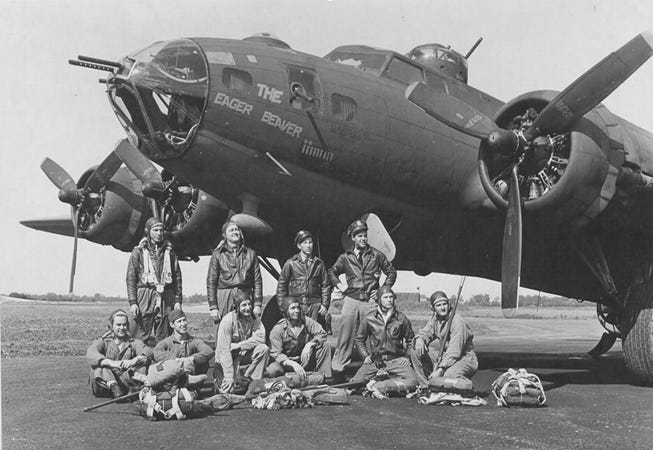
RAF Bomber Command’s unhappy experiences in 1939-41 had turned it against daylight bombing and solidified the British commitment to area bombing by night. But senior American airmen begged to differ. They were confident that B-17s and B-24s with their heavy defensive armament could fight their way through enemy defenses in daylight and, thanks to the top-secret Norden bombsight, hit and destroy pinpoint targets. It was true that VIII Bomber Command’s attacks on the German U-boat bases in France had been none too successful. But this was due mainly to a lack of bombs large and powerful enough to destroy the concrete and steel pens that protected the submarines. Industrial targets were obviously more vulnerable.
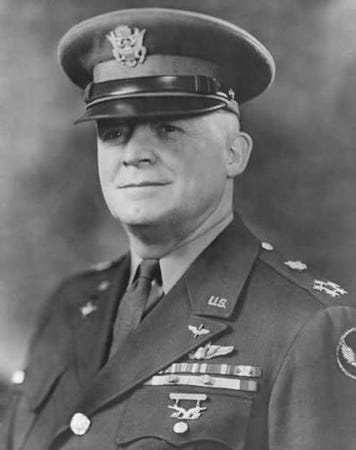
But which industrial targets? That was the question. In December 1942, therefore, a group titled the Committee of Operations Analysts was set up within Headquarters, US Army Air Forces (HQ USAAF), to study the problem of target selection for a strategic air offensive against Germany. Its report was submitted to the USAAF commander, Lieutenant General H.H. “Hap” Arnold, on 8 March 1943.
The COA’s methodology and conclusions reflected the core principles of US strategic airpower doctrine:
(1) That scientific analysis could produce an accurate picture of the enemy’s industrial infrastructure and identify the key industries whose destruction would decisively cripple the German war effort in the shortest possible time.
(2) That daylight precision bombing attacks could in fact destroy such targets.
Distinguishing key industries from those of secondary importance required attention to detail but was not too complex an undertaking. Beyond that, however, the reliability of the COA analysis was open to question.
For example, assuming that German steel production was designated as a key industry, what percentage of it had to be destroyed in order to cripple the enemy’s war effort? The answer depended upon various factors that were hard to nail down. What were Germany’s actual minimum requirements for steel? How much spare capacity was there in the German steel industry? How much finished steel did the Germans have stockpiled? Were there other industrial facilities that could be repurposed to produce steel if need be? How much additional steel could the Germans obtain from plants in the countries they occupied? Were there nonessential sectors of the economy where the demand for steel could be reduced? How difficult would it be to destroy steel production facilities by bombing them? And what was the time lag between “mission accomplished” and the appearance of adverse effects on the German war effort as a whole?
The COA’s report to General Arnold reflected the difficulty of answering these questions. The COA had been asked to estimate as precisely as possible the date by which the CBO would reduce German military strength to the point where an invasion of Europe would be feasible. But the committee was unable to produce such an estimate. One problem was that the size and capabilities of the air forces that might be made available for POINTBLANK remained a question mark. Moreover, the operational record of VIII Bomber Command to date did not provide sufficient data on such matters as bombing accuracy.
The COA did, however, opine that “It is better to cause a high degree of destruction in a few really essential industries or services than to cause a small degree of destruction in many industries,” and that the destruction of some sixty vital targets would significantly degrade and might actually paralyze the German war effort.
Based on the COA report, The British Ministry of Economic Warfare, the RAF Air Staff, and the Eighth Air Force staff drew up a list of seventy-six key targets, prioritized as follows:
· U-boat construction facilities and bases
· Aircraft-related industries
· Ball bearing factories
· Rubber and tire production plants
· Military vehicle production plants
The priority given to U-boat-related targets reflected continuing concern about the course of the Battle of the Atlantic—which, as it happened, reached its turning point in April 1943. That aside, there was general agreement that POINTBLANK should focus initially on the Luftwaffe, especially its day and night fighter forces. Degrading them was the necessary preliminary to a full-scale strategic bomber offensive against German industry and, later on, to the invasion of France and the liberation of Europe.
Having set forth the general strategic objectives, the planners turned their attention to the question of force structure. To that end, Lieutenant General Ira Eaker, the Eighth Air Force commander, set up a committee of senior staff officers, to which an RAF officer was added, to determine the required size of the combined bombardment force and the order in which targets should be struck. The resulting “Plan for the Combined Bomber Offensive from the United Kingdom,” known informally as the CBO Plan, was endorsed by the responsible American and British senior commanders.
The CBO plan envisioned the destruction or neutralization of a set percentage of each target class, for example 43% per cent of German fighter manufacturing capacity. Ball-bearing production was to be reduced by 76%; oil production by 48%; synthetic rubber production by 50%. The planners realized, of course, that the imponderables of war were not and indeed could not be factored into these precise numbers. The CBO was something new; there was very little historical data on which to go by.
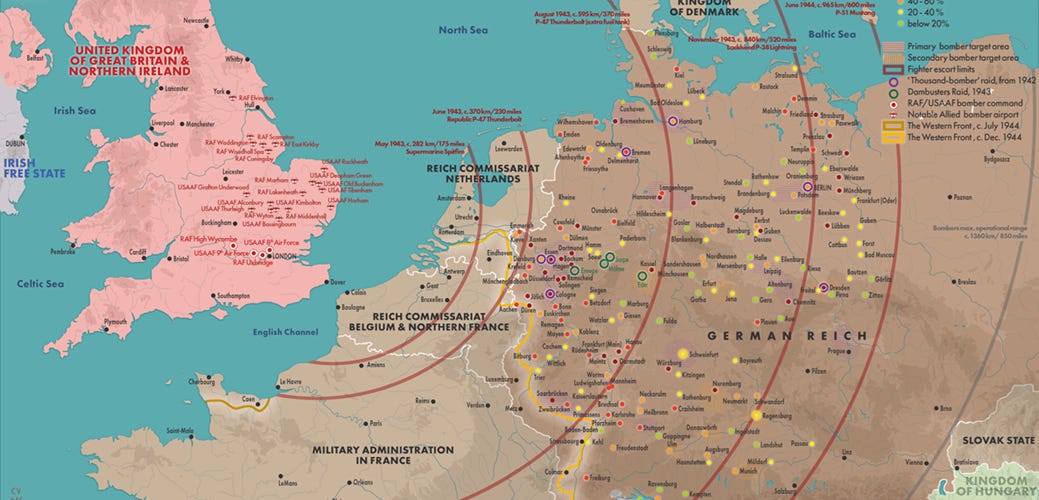
But the planes, the men, the bombs, the whole complex infrastructure of the American and British air forces were nearing their maximum potential. POINTBLANK was on, and it would prove decisive for the outcome of the Second World War—though not necessarily in the way that the airman envisioned.
From what we know about the Iran War, American air forces retain their optimism about their ability to be decisive.
They also continue to underestimate the enemy's ability to adapt/substitute.
And as in WW2, our leadership continues to be less than truthful in managing our expectations.